

Quick Answer
The message writing format is a short, fixed layout used to pass on information when the receiver is away. It has a heading, the date and time, a salutation, a body of about 50 words and the sender’s name. A good message is brief, factual and complete, answering who, what, when and where.
Key Takeaways
- A message has five parts: heading, date and time, salutation, body and sender’s name.
- Most school exams ask for a message of around 50 words, so check your board’s current instructions.
- The body should answer who called or came, what they want, and what the receiver must do.
- Messages are written in the third person for the receiver and kept free of extra opinions.
- Always include the date and time, because a message without them is hard to act on.
What Is Message Writing?
Message writing is the skill of recording information for someone who could not be present to receive it. A friend phones while you are out, a visitor arrives at your parents’ home, or a teacher wants to pass on a change in the timetable. You write the details down so the right person can act on them later.
In school English papers, message writing is a short writing task. You are given a situation and asked to write the message in a limited number of words. In daily life the same skill appears as a note on the fridge, a sticky note on a desk, a text to a colleague or a voicemail summary. The format below keeps the school version tidy, and the habits behind it help everywhere.
If you are also preparing for other writing tasks, it helps to see how this fits with longer layouts such as the formal letter format and the informal letter format. A message is the shortest cousin of those forms.
Message Writing Format: Parts of a Message
The message writing format follows a simple order. Each part has one job, and leaving one out usually costs marks in an exam.
- Heading: write the word MESSAGE at the top, usually in capitals and often placed in a box or centred.
- Date and time: note when the message was written, for example 14 March 2026, 4:30 p.m.
- Salutation: address the receiver by name, such as Dear Mother or Dear Ravi.
- Body: state the information in two or three short sentences, around 50 words in total.
- Sender’s name: end with the name of the person who wrote the message, placed at the bottom left.
Some boards also expect the receiver’s name on a separate line or ask you to leave out the complimentary close. Follow the sample given in your textbook or exam instructions when they differ from this layout.
Layout at a Glance
| Part | What to write | Where it goes |
|---|---|---|
| Heading | The word MESSAGE | Top, centred or boxed |
| Date and time | Day, month, year and time | Left side, below the heading |
| Salutation | Dear plus the receiver’s name | Left side |
| Body | Who, what, when, where and the action needed | Main section |
| Sender’s name | Your name | Bottom left |
How to Write a Message Step by Step
A good message comes from a short routine. Follow these steps every time and the layout will become automatic.
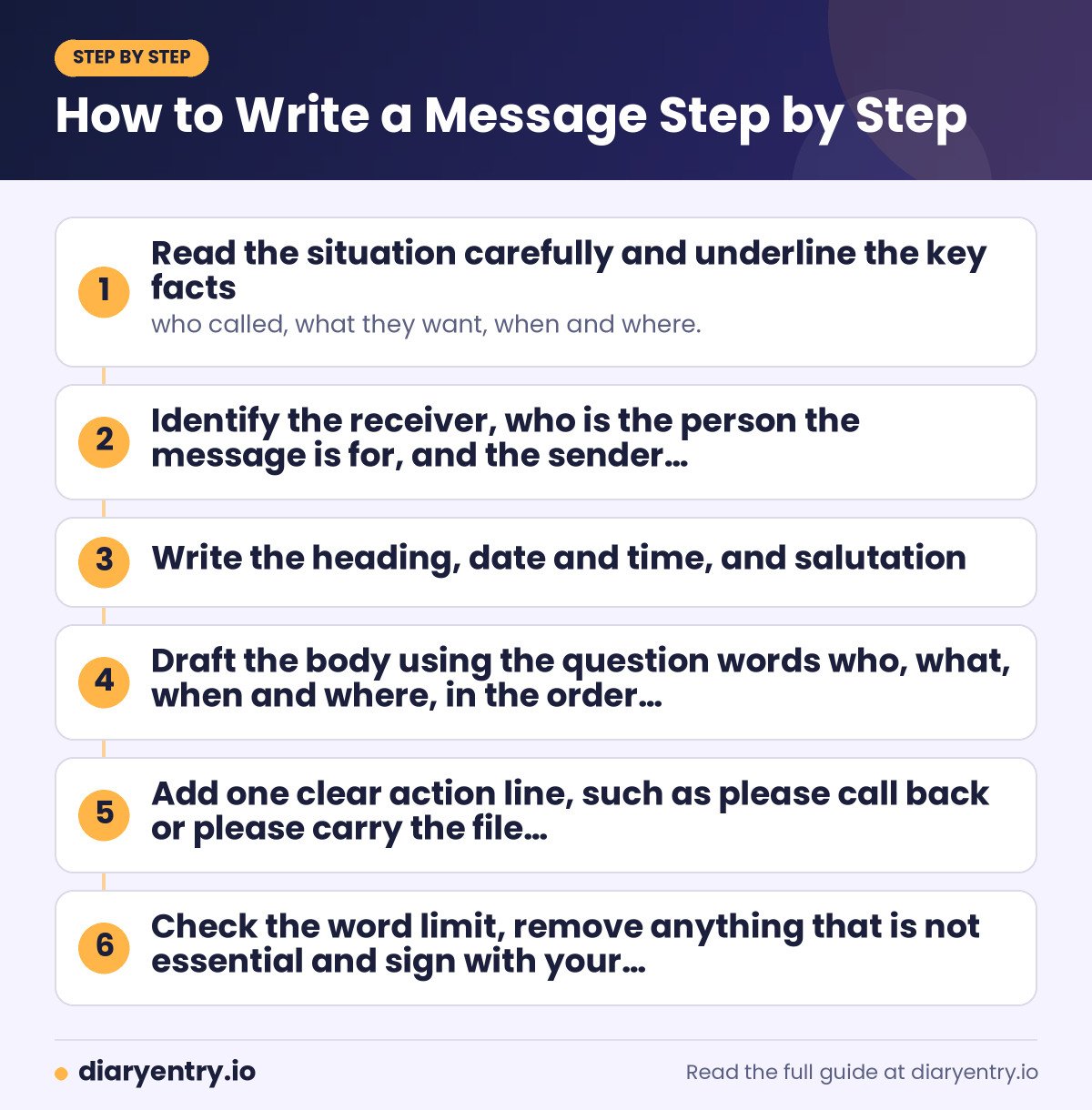
- Read the situation carefully and underline the key facts: who called, what they want, when and where.
- Identify the receiver, who is the person the message is for, and the sender, who is you.
- Write the heading, date and time, and salutation.
- Draft the body using the question words who, what, when and where, in the order the receiver needs them.
- Add one clear action line, such as please call back or please carry the file tomorrow.
- Check the word limit, remove anything that is not essential and sign with your name.
Use the Five Question Words
Before writing the body, ask yourself five quick questions. Who is the message from? What do they want? When did they call or when is the event? Where is it happening? What should the receiver do? If your body answers all five, it is almost certainly complete.
Keep the Language Simple
Messages are read in a hurry, so use short sentences and everyday words. Avoid long introductions. Skip phrases like I am writing to inform you, which belong to formal letters, and go straight to the information.
Message Writing Samples
Seeing a complete message makes the rules easier to remember. Here are three samples at different levels of difficulty.
Sample 1: A Phone Call for Your Brother
You are Neha. Your brother Arjun is out, and his friend Kabir phones to say that tomorrow’s cricket practice has moved from 6 a.m. to 7 a.m.
MESSAGE
12 March 2026, 5:15 p.m.
Dear Arjun,
Your friend Kabir called while you were out. He said tomorrow’s cricket practice has been moved from 6 a.m. to 7 a.m. because the ground is being repaired. Please carry your kit and reach the ground by 6:45 a.m.
Neha
Sample 2: A Visitor at Home
You are Rohan. A courier arrived at your home while your mother was at work, and you must leave a message for her.
MESSAGE
3 April 2026, 11:00 a.m.
Dear Mother,
A courier from Sharma Books came at 10:30 a.m. with a parcel in your name. I could not receive it because I did not have your authority letter. He will return tomorrow between 10 a.m. and 12 noon. Please keep the letter ready.
Rohan
Sample 3: A Change at School
You are the school captain, Meera. The principal asks you to inform Class 10 that the science test on Friday has been postponed.
MESSAGE
20 August 2026, 9:40 a.m.
Dear Students of Class 10,
The principal has informed me that Friday’s science test is postponed to Monday, 25 August, in the second period. The syllabus remains the same. Please use the extra days to revise Chapters 4 and 5 and complete pending notebooks.
Meera, School Captain
Message Writing vs Other Short Writing Formats
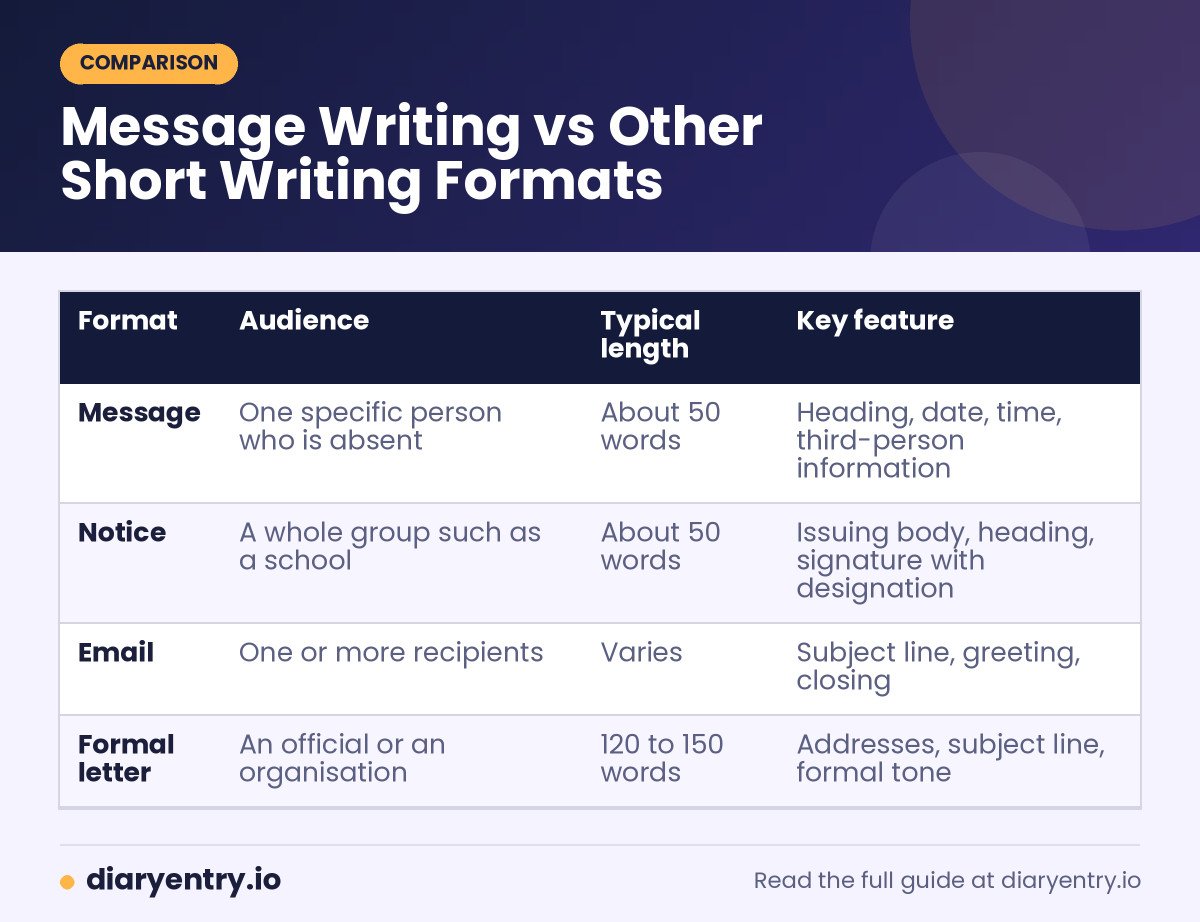
Students often mix up messages with notices, emails and letters. They all pass on information, yet each has a different audience and layout. The table below shows the main differences.
| Format | Audience | Typical length | Key feature |
|---|---|---|---|
| Message | One specific person who is absent | About 50 words | Heading, date, time, third-person information |
| Notice | A whole group such as a school | About 50 words | Issuing body, heading, signature with designation |
| One or more recipients | Varies | Subject line, greeting, closing | |
| Formal letter | An official or an organisation | 120 to 150 words | Addresses, subject line, formal tone |
For group announcements, see our guide to notice writing for Class 12. For digital correspondence, our email writing format guide covers subject lines, greetings and closings in detail.
Common Mistakes in Message Writing
Most lost marks come from a few predictable errors. Watch for these.
- Forgetting the date and time, which makes the message impossible to act on.
- Writing the sender’s address or a long letter-style opening that is not needed.
- Exceeding the word limit by adding opinions or repeating facts.
- Leaving out the action the receiver must take.
- Using the wrong person, for example writing I want when you are passing on someone else’s request.
- Using a casual style with abbreviations, such as u and pls, in an exam answer.
A Quick Self-Check
After you finish, read the message once as if you were the receiver. Could you act on it without asking a single question? If yes, the message is ready. If you would need to call back for details, the message is missing something.
Tips to Score Full Marks
A few habits separate a good message from a perfect one.
- Count your words in the body only, as most boards do not count the heading, date or names. Check your own board’s instructions.
- Write numbers and times clearly, such as 7 a.m. instead of seven in the morning.
- Use polite words such as please when asking for action.
- Place the most important fact first, then the supporting details.
- Practise with five or six situations a week, writing each in under five minutes.
Real-Life Uses of Message Writing
The same skill matters well beyond exams. At work, you pass on call details to a colleague. At home, you leave a note for a family member. In a team chat, you summarise a meeting for someone who missed it. Each of these needs the same discipline: identify the facts, order them by importance and state the action.
Keeping a short daily record also strengthens this habit. If you enjoy writing, a diary builds the same clear, factual style over time, and our guide on how to write a diary entry shows how to turn daily events into clean, readable sentences. The 4-Week Diary Entry Course is one option for learners who want guided daily practice.
Practice Situations to Try
The fastest way to improve is to write messages from real situations. Use the five situations below, set a timer for five minutes each and keep the body close to 50 words.
- Your aunt phones while your parents are out and says she will arrive on Sunday at 8 a.m. by the morning train.
- A classmate calls to say the project submission has moved from Wednesday to Thursday.
- The plumber visited while you were alone at home and will return on Saturday at 10 a.m.
- Your friend asks you to tell your sister that the library book must be returned by Monday.
- A neighbour wants your father to know that the society meeting is at 7 p.m. in the community hall.

After writing, swap with a friend and check whether each message answers who, what, when, where and what to do. This peer check is quick and reveals gaps you might not notice in your own writing.
How to Adapt the Tone of a Message
The format stays the same, yet the tone changes with the receiver. When you write to a parent or teacher, use respectful words and a polite request, such as Please keep the letter ready. When you write to a friend or sibling, the language can be lighter, though still clear and complete. In both cases, avoid slang and keep the facts in order.
Writing for Different Receivers
- Family members: warm and direct, with the action in the last line.
- Teachers or officials: polite and precise, with exact dates and names.
- Classmates: friendly and short, focused on the task or deadline.
- Colleagues: professional, with the call details and next step.
Handling Missing Information
Sometimes the caller does not give every detail. In an exam situation, use only the facts provided and do not invent extra ones. In real life, note what you do not know, such as caller did not leave a number, so that the receiver can follow up. Being honest about gaps is better than guessing.
Written Message or Text Message?
A text message on your phone follows the same thinking even though the layout is relaxed. Lead with the key fact, add the time or place, and finish with the request. Remember that the exam format with heading, date and time is a formal practice version of this everyday habit.
Frequently Asked Questions
What is the format of message writing?
The format has a heading (MESSAGE), the date and time, a salutation, a body of about 50 words and the sender’s name at the bottom. The body states who, what, when and where.
How many words should a message be?
Most school boards ask for around 50 words. Rules can change, so check the latest instructions for your class and board.
Do I need to write the time in a message?
Yes. Time helps the receiver understand how recent the message is and whether the information is still current, so include it with the date.
Who is the sender and who is the receiver?
The sender is the person writing the message, which is you. The receiver is the person the message is meant for, such as a family member or a classmate.
What is the difference between a message and a notice?
A message is for one specific person and records an individual communication. A notice is for a group and is issued by an organisation, with a signature and designation.
Can I use abbreviations in a message?
In exams, avoid informal abbreviations. Standard ones such as a.m. and p.m. are fine. In daily life, use whatever your receiver will understand easily.
Conclusion
The message writing format is small but strict: heading, date and time, salutation, a focused body and the sender’s name. Answer who, what, when and where, add one clear action line, and stay close to the word limit. Practise with different situations and the format becomes second nature, in exams and in everyday life.