
Quick Answer
Types of clauses are the groups of words that contain a subject and a verb and work as building blocks of sentences. English has two main types: independent clauses, which can stand alone, and dependent clauses, which cannot. Dependent clauses are further divided into noun clauses, adjective clauses and adverb clauses.
Key Takeaways
- A clause is a group of words with its own subject and verb, and it is different from a phrase, which has no subject-verb pair.
- An independent clause makes complete sense alone, while a dependent clause needs an independent clause to finish the idea.
- Dependent clauses act as nouns, adjectives or adverbs inside a larger sentence.
- Subordinating conjunctions and relative pronouns usually signal a dependent clause.
- Knowing the types of clauses helps you avoid fragments, comma splices and run-on sentences.
What Is a Clause?
A clause is a group of words that contains a subject (who or what the sentence is about) and a predicate with a finite verb (what the subject does or is). “Rain fell” is a clause. “The rain fell heavily on the old roof” is also a clause, only longer.
Every sentence has at least one clause. Some sentences have two, three or more. Learning to spot clauses is the fastest way to understand how sentences are put together, and it is the base for punctuation, sentence variety and error-free writing.
Clause vs phrase
A phrase is a group of words that works together but does not have a subject and a finite verb. “On the old roof” and “running through the park” are phrases. They add detail, but they cannot be sentences on their own. Our guide to prepositions shows how many phrases are built, since prepositional phrases are among the most common.
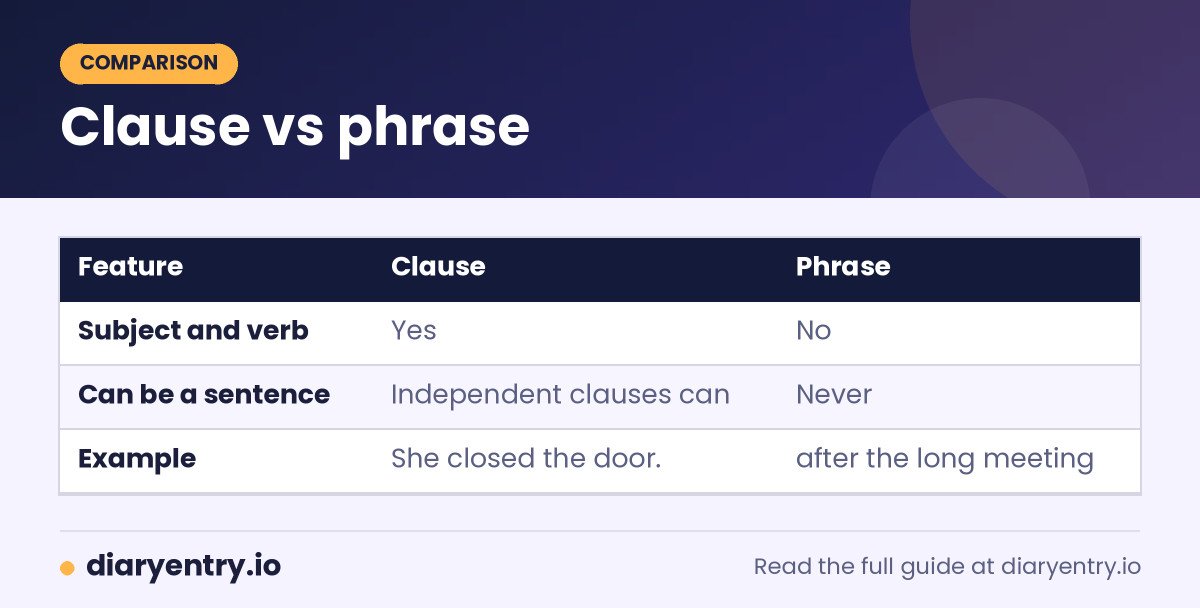
| Feature | Clause | Phrase |
|---|---|---|
| Subject and verb | Yes | No |
| Can be a sentence | Independent clauses can | Never |
| Example | She closed the door. | after the long meeting |
The Two Main Types of Clauses
The first split is simple. Every clause is either independent or dependent, and the difference is whether it can stand alone.
Independent clauses (main clauses)
An independent clause expresses a complete thought. You can put a capital letter at the start and a full stop at the end, and it is a proper sentence.
- The students finished their projects.
- I love early mornings.
- The train arrived late.
Dependent clauses (subordinate clauses)
A dependent clause has a subject and a verb but leaves the thought unfinished. It depends on an independent clause to make sense.
- Because the train arrived late (what happened?)
- Although I love early mornings (so what?)
- Who finished their projects (who is this about?)
Add an independent clause, and the thought is complete: “Because the train arrived late, we missed the meeting.”
Types of Dependent Clauses
Dependent clauses are grouped by the job they do in the sentence. Each one acts like a noun, an adjective or an adverb.
| Type | Job in the sentence | Common starters | Example |
|---|---|---|---|
| Noun clause | Works as a noun (subject, object, complement) | that, what, whether, if, who, why, how | I know that she is right. |
| Adjective clause | Describes a noun or pronoun | who, whom, whose, which, that | The book that I borrowed is thrilling. |
| Adverb clause | Tells when, where, why, how or under what condition | when, because, if, although, while, since | We left when the rain stopped. |
Noun Clauses
A noun clause does everything a noun can do. It can be the subject of a sentence, the object of a verb, the object of a preposition or a complement.
Noun clause as subject
- What she said surprised everyone.
- That he forgot the date is not unusual.
Noun clause as object
- I wonder whether the shop is open.
- She told me that the exam was postponed.
Noun clause as complement
- The problem is that we have no time.
- Her wish is that everyone stays safe.
Noun clause as object of a preposition
- We talked about how the festival began.
- Pay attention to what the teacher says.
A quick test: if you can replace the clause with “it” or “something”, it is probably a noun clause. “I know it” works for “I know that she is right”.
Adjective Clauses (Relative Clauses)
An adjective clause gives more information about a noun. It starts with a relative pronoun (who, whom, whose, which, that) or a relative adverb (where, when, why). You can review these words in our guide to types of pronouns.
- The teacher who inspired me retired last year.
- This is the house where I grew up.
- The author whose book won the prize is visiting our school.
Defining and non-defining clauses
A defining (restrictive) clause is essential. Without it, the sentence changes meaning, and no commas are used.
- Students who revise regularly usually score better.
A non-defining (non-restrictive) clause adds extra information and is placed inside commas.
- My brother, who lives in Pune, visits us every winter.
Use “that” for defining clauses about things and “which” for non-defining clauses. “Who” is used for people in both kinds.
Adverb Clauses
An adverb clause modifies a verb, an adjective or another adverb. It answers questions such as when, where, why, how, under what condition and in spite of what. Most adverb clauses start with a subordinating conjunction. For a full list of these joining words, see our page on conjunctions.
| Kind of adverb clause | Starters | Example |
|---|---|---|
| Time | when, while, before, after, until, as soon as | Call me when you reach home. |
| Place | where, wherever | Put the box where it was. |
| Reason | because, since, as | He stayed in because it was raining. |
| Condition | if, unless, provided that | If you heat ice, it melts. |
| Concession | although, though, even though | Although she was tired, she kept working. |
| Purpose | so that, in order that | She woke early so that she could study. |
| Result | so… that, such… that | It was so cold that the lake froze. |
| Manner | as, as if, as though | He spoke as if he knew the answer. |
| Comparison | than, as… as | She runs faster than I do. |
Condition clauses deserve special attention because of their tense patterns. Our guide to conditional sentences covers zero, first, second, third and mixed conditionals in detail.
Types of Clauses by Sentence Structure
When you combine clauses, you get the four sentence structures. Here is how the clause types build them.
| Sentence type | Clause pattern | Example |
|---|---|---|
| Simple | One independent clause | The sun rose. |
| Compound | Two or more independent clauses | The sun rose, and the birds began to sing. |
| Complex | One independent + one or more dependent | When the sun rose, the birds began to sing. |
| Compound-complex | Two or more independent + at least one dependent | The sun rose, and the birds sang because the morning was warm. |
You can see more examples of each structure in our types of sentences guide.
How to Identify Clauses: A Step-by-Step Method
Follow these steps whenever a long sentence confuses you.
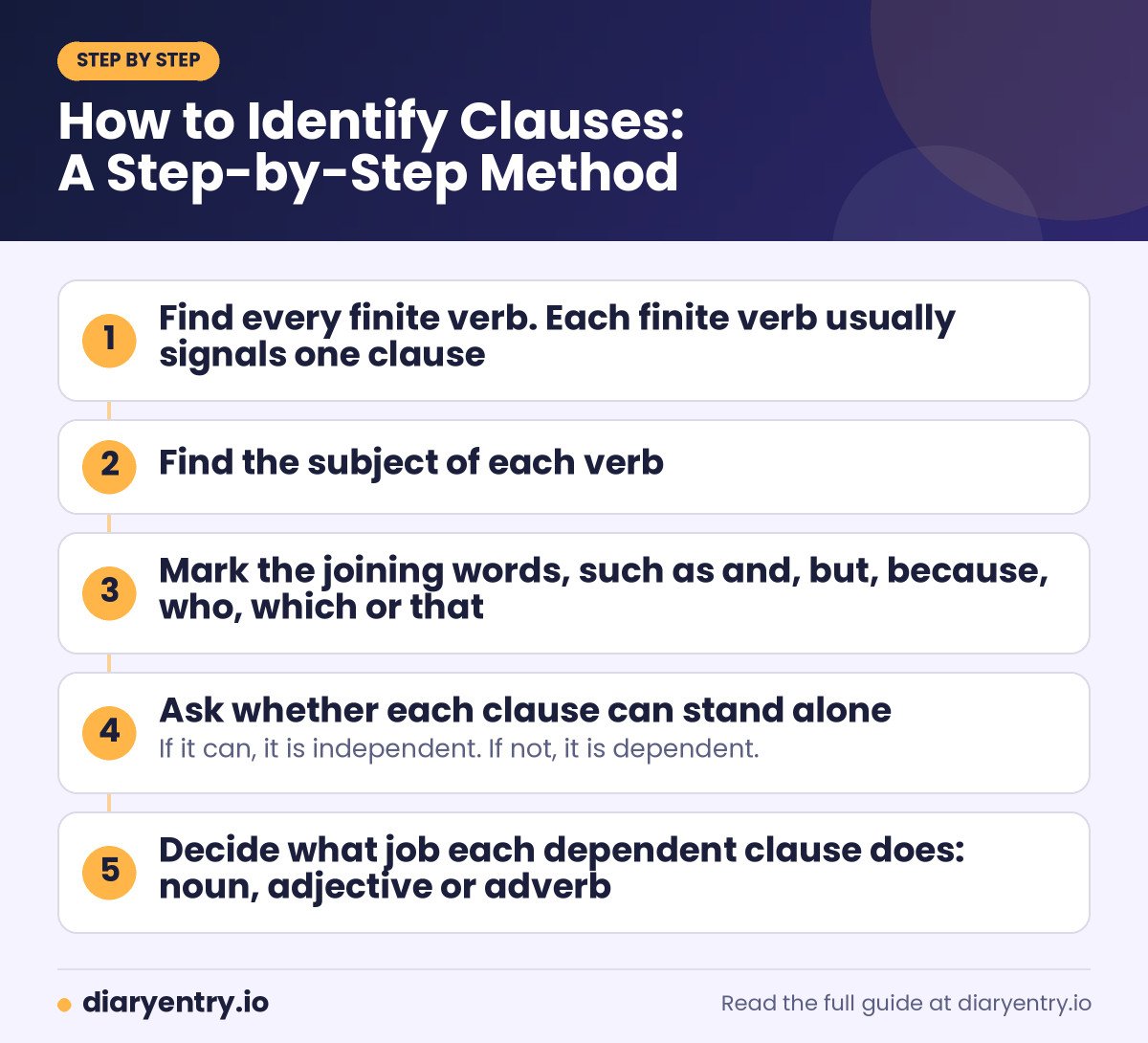
- Find every finite verb. Each finite verb usually signals one clause.
- Find the subject of each verb.
- Mark the joining words, such as and, but, because, who, which or that.
- Ask whether each clause can stand alone. If it can, it is independent. If not, it is dependent.
- Decide what job each dependent clause does: noun, adjective or adverb.
Try it on this sentence: “The girl who won the race said that she trained daily because she loves running.”
- “The girl … said” is the independent clause.
- “who won the race” is an adjective clause describing “girl”.
- “that she trained daily” is a noun clause, the object of “said”.
- “because she loves running” is an adverb clause of reason.
Punctuation Rules for Clauses
Good punctuation makes clause boundaries clear.
- Two independent clauses with a conjunction: use a comma before the conjunction. “I wanted to go, but it was late.”
- Two independent clauses with no conjunction: use a semicolon. “I wanted to go; it was late.”
- Dependent clause before the main clause: use a comma. “When the bell rang, we left.”
- Dependent clause after the main clause: usually no comma. “We left when the bell rang.”
- Non-defining relative clause: use commas around it.
Common Clause Mistakes
These errors appear often in school and college writing.
1. Sentence fragments
A dependent clause on its own is a fragment. “Because I was late.” is incomplete. Join it to a main clause: “I apologised because I was late.”
2. Comma splices
Joining two independent clauses with only a comma is incorrect. “It was late, we went home.” should be “It was late, so we went home.” or “It was late; we went home.”
3. Wrong choice of who or whom
Use “who” when it acts as the subject and “whom” when it acts as the object. “The man who called” is correct. “The man whom I called” is correct.
4. Mismatched verbs
The verb in the main clause must agree with its own subject, not the noun inside a dependent clause. Our guide to subject verb agreement shows how to avoid this trap.
Clauses in Reported Speech
Reported speech often uses a noun clause as the object of the reporting verb. In “She said that she was tired”, the clause “that she was tired” is a noun clause. Tense and pronoun changes inside that clause follow the rules on direct and indirect speech.
Why Clauses Matter for Better Writing
Knowing the types of clauses is not only about passing grammar tests. Writers use them to control rhythm. A string of short independent clauses sounds sharp and quick, while a sentence with a dependent clause lets you explain a reason, a time or a condition without starting a new sentence. Mixing both gives your writing variety.
For example, compare “I was nervous. I walked on stage. I smiled.” with “Although I was nervous, I smiled as I walked on stage.” The second version connects the ideas and shows how they relate. Readers follow your thinking more easily when clauses are chosen with care.
Practice Exercise: Identify the Clause Type
Label each underlined idea as independent, noun, adjective or adverb clause before reading the answers.
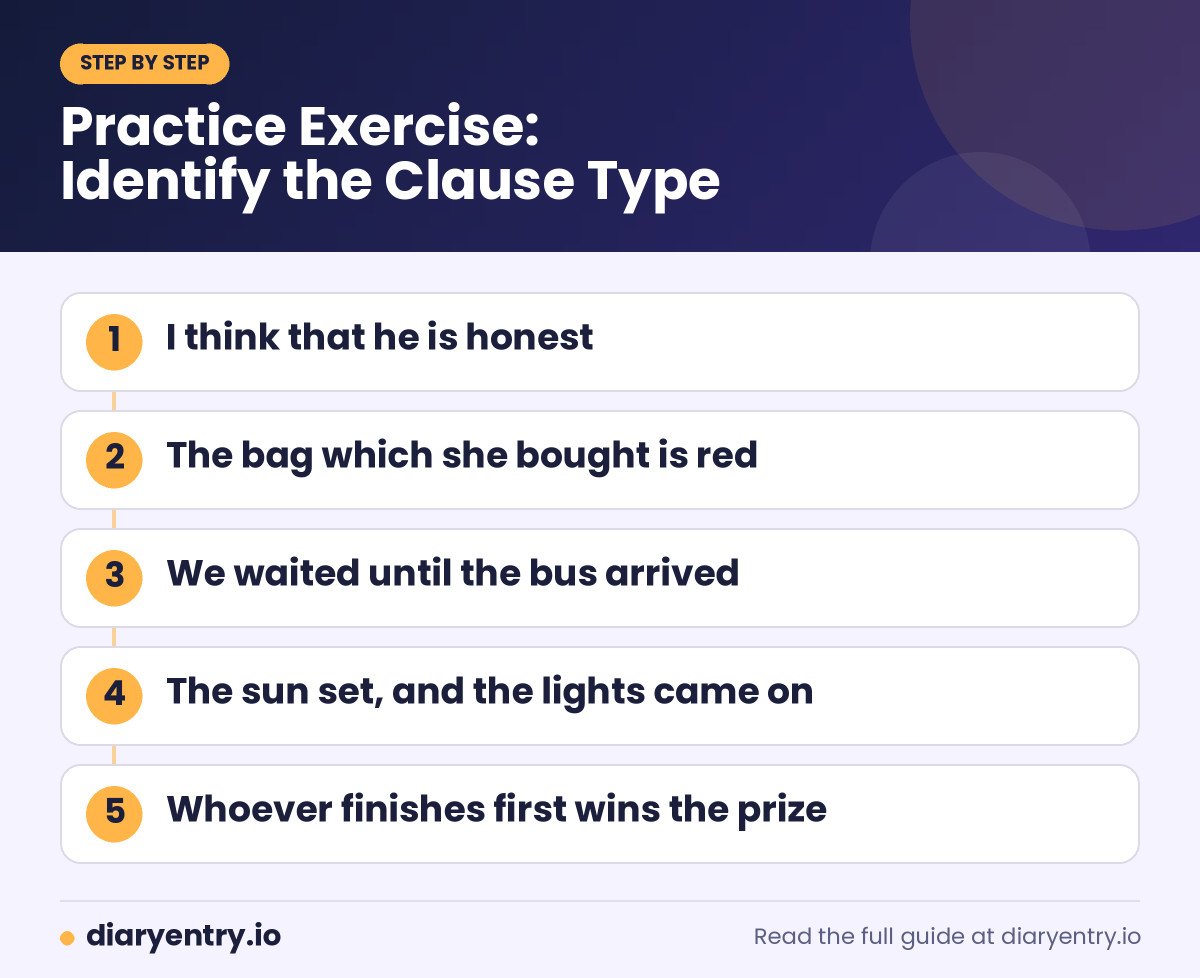
- I think that he is honest.
- The bag which she bought is red.
- We waited until the bus arrived.
- The sun set, and the lights came on.
- Whoever finishes first wins the prize.
Answers: 1 noun clause, 2 adjective clause, 3 adverb clause, 4 two independent clauses, 5 noun clause (subject).
Tips to Master Clauses
Grammar sticks when you use it in your own writing. Try this routine: write one real sentence every day that contains a dependent clause, then underline the clause and label its type. A daily diary is a perfect place for it, because you naturally explain reasons, times and conditions with “because”, “when” and “if”.
If you want a gentle structure for that habit, the 4-Week Diary Entry Course is built around short, regular writing practice. It is not a grammar course, but writing every day gives you plenty of chances to use clauses naturally.
Frequently Asked Questions About Types of Clauses
What are the types of clauses in English?
There are two main types: independent clauses and dependent clauses. Dependent clauses are divided into noun clauses, adjective clauses and adverb clauses.
What is the difference between a clause and a sentence?
A sentence is a complete unit that starts with a capital letter and ends with punctuation. It can contain one clause or several. A clause is a part of a sentence with a subject and a verb.
Can a clause be a sentence?
Only an independent clause can be a sentence on its own. A dependent clause by itself is a fragment.
How do I tell a noun clause from an adjective clause?
A noun clause replaces a noun and answers “what” or “who” in the sentence. An adjective clause follows a noun and describes it. Try replacing the clause with “it”: if that works, it is a noun clause.
Do all clauses need a conjunction?
No. A single independent clause needs no conjunction. Conjunctions or relative pronouns are used to join clauses together or introduce dependent clauses.
What is a relative clause?
A relative clause is another name for an adjective clause. It begins with who, whom, whose, which, that, where, when or why and gives more detail about a noun.
How many clauses can a sentence have?
There is no fixed limit. Most everyday sentences have one to three, but long academic sentences can have more.
Conclusion
The types of clauses form the skeleton of every English sentence. Once you can separate independent from dependent clauses and recognise noun, adjective and adverb clauses, long sentences stop being scary. Start with one sentence from your own writing today, mark its clauses, and you will soon see patterns everywhere.