
Quick Answer
Synonyms and antonyms are pairs of words defined by meaning. Synonyms are words with the same or very similar meaning, such as big and large, while antonyms are words with opposite meanings, such as big and small. Knowing synonyms and antonyms builds vocabulary, helps you avoid repetition and makes writing more precise.
Key Takeaways
- A synonym has the same or nearly the same meaning as another word, but few synonyms are perfectly interchangeable.
- An antonym has the opposite meaning, and there are three main kinds: gradable, complementary and relational.
- Context decides which synonym fits best, because words carry different tones and strengths.
- Learning words in pairs and groups is one of the fastest ways to expand vocabulary.
- Reading, journaling and regular revision help the words stay in memory.
What Are Synonyms?
A synonym is a word that has the same or almost the same meaning as another word. Happy and joyful, begin and start, and quick and fast are all pairs of synonyms. The word comes from Greek roots meaning “same name”.
True synonyms are rare. Most synonyms differ slightly in strength, formality or feeling. Consider the words thin, slim and skinny. All describe a body with little fat, but slim sounds pleasant, skinny can sound unkind and thin is neutral. Choosing the right one depends on what you want to say and who will read it.
Synonyms belong to the same part of speech. Two nouns can be synonyms, two verbs can be synonyms and so on. If you want to review the word classes first, see our guide to parts of speech with definitions and examples.
What Are Antonyms?
An antonym is a word that means the opposite of another word. Hot and cold, early and late, and increase and decrease are antonyms. The word comes from Greek roots meaning “opposite name”.
Like synonyms, antonyms must match in part of speech, and many words have more than one antonym depending on the meaning. The word light has the antonym heavy when it means weight, dark when it means brightness, and serious when it means mood. Always check the context before choosing an opposite.
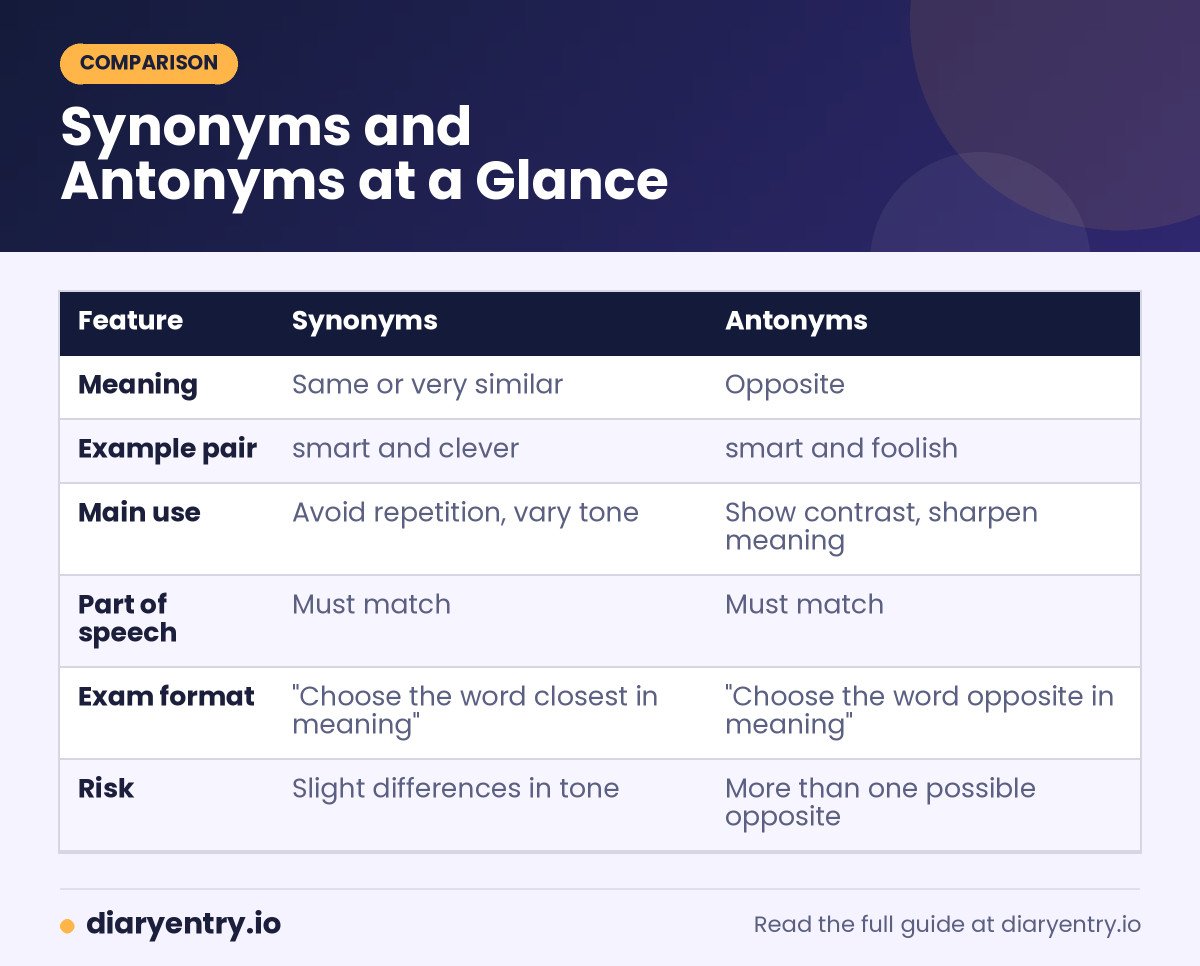
Synonyms and Antonyms at a Glance
| Feature | Synonyms | Antonyms |
|---|---|---|
| Meaning | Same or very similar | Opposite |
| Example pair | smart and clever | smart and foolish |
| Main use | Avoid repetition, vary tone | Show contrast, sharpen meaning |
| Part of speech | Must match | Must match |
| Exam format | “Choose the word closest in meaning” | “Choose the word opposite in meaning” |
| Risk | Slight differences in tone | More than one possible opposite |
Common Synonyms With Examples
The list below groups everyday words with useful synonyms. Notice that each sentence shows how the synonym works in context.
| Word | Synonyms | Example sentence |
|---|---|---|
| Happy | glad, cheerful, joyful, delighted | She was delighted with her result. |
| Sad | unhappy, sorrowful, gloomy, downcast | He looked downcast after the match. |
| Big | large, huge, enormous, vast | They live in a vast house. |
| Small | little, tiny, petite, compact | We found a tiny shell. |
| Smart | clever, intelligent, bright, sharp | She is a bright student. |
| Brave | courageous, fearless, bold, valiant | The firefighter was fearless. |
| Beautiful | lovely, pretty, gorgeous, stunning | The view was stunning. |
| Begin | start, commence, initiate, launch | The ceremony will commence at ten. |
| End | finish, conclude, complete, terminate | Please conclude your speech. |
| Ask | enquire, question, request, inquire | I will enquire about the fees. |
| Help | assist, aid, support, back | Volunteers assist the elderly. |
| Tired | weary, exhausted, drained, sleepy | The runners were exhausted. |
Common Antonyms With Examples
| Word | Antonym | Example sentence |
|---|---|---|
| Hot | cold | The tea was hot, but the juice was cold. |
| Strong | weak | A strong team can hide a weak start. |
| Rich | poor | The story is about a rich king and a poor farmer. |
| Ancient | modern | The museum mixes ancient tools and modern art. |
| Accept | reject | She did not reject the offer; she accepted it. |
| Victory | defeat | Victory felt sweeter after the earlier defeat. |
| Generous | selfish | He is generous with time, never selfish. |
| Expand | shrink | Metal expands in heat and shrinks in cold. |
| Arrive | depart | The train arrives at six and departs at seven. |
| Honest | dishonest | An honest answer beats a dishonest excuse. |
| Permanent | temporary | This is a temporary fix, not a permanent one. |
| Include | exclude | Include every name; exclude no one. |
Types of Antonyms
Not all opposites work in the same way. Linguists usually divide antonyms into three groups, and understanding them explains why some opposite pairs feel more absolute than others.
Gradable Antonyms
Gradable antonyms sit at opposite ends of a scale with a middle ground between them. Hot and cold, tall and short, and happy and sad are gradable. Something can be warm, lukewarm or cool, so denying one does not automatically assert the other. These pairs can also be compared: hotter, colder, happier. For more on comparing words along a scale, read our explanation of degrees of comparison.
Complementary Antonyms
Complementary antonyms leave no middle ground. If one is true, the other is false. Alive and dead, true and false, on and off, and present and absent are complementary. A light switch is either on or off, and a student is either present or absent.
Relational Antonyms
Relational (or converse) antonyms describe the same relationship from opposite points of view. Buy and sell, teacher and student, parent and child, and give and receive are relational. One cannot exist without the other: if Anil sells a book to Meera, then Meera buys a book from Anil.
Antonyms Formed With Prefixes
Many antonyms are made by adding a negative prefix to a word. This is a quick way to form opposites and a favourite exam topic.
- un-: happy and unhappy, kind and unkind, fair and unfair.
- in- / im- / il- / ir-: visible and invisible, possible and impossible, legal and illegal, regular and irregular.
- dis-: agree and disagree, appear and disappear, honest and dishonest.
- non-: sense and nonsense, stop and non-stop.
- mis-: understand and misunderstand, lead and mislead.
Be careful, because prefixes are not always safe. Inflammable does not mean “not flammable”, and a few words do not follow the pattern at all. Always check a dictionary if you are unsure.
How to Choose the Right Synonym or Antonym: Step by Step
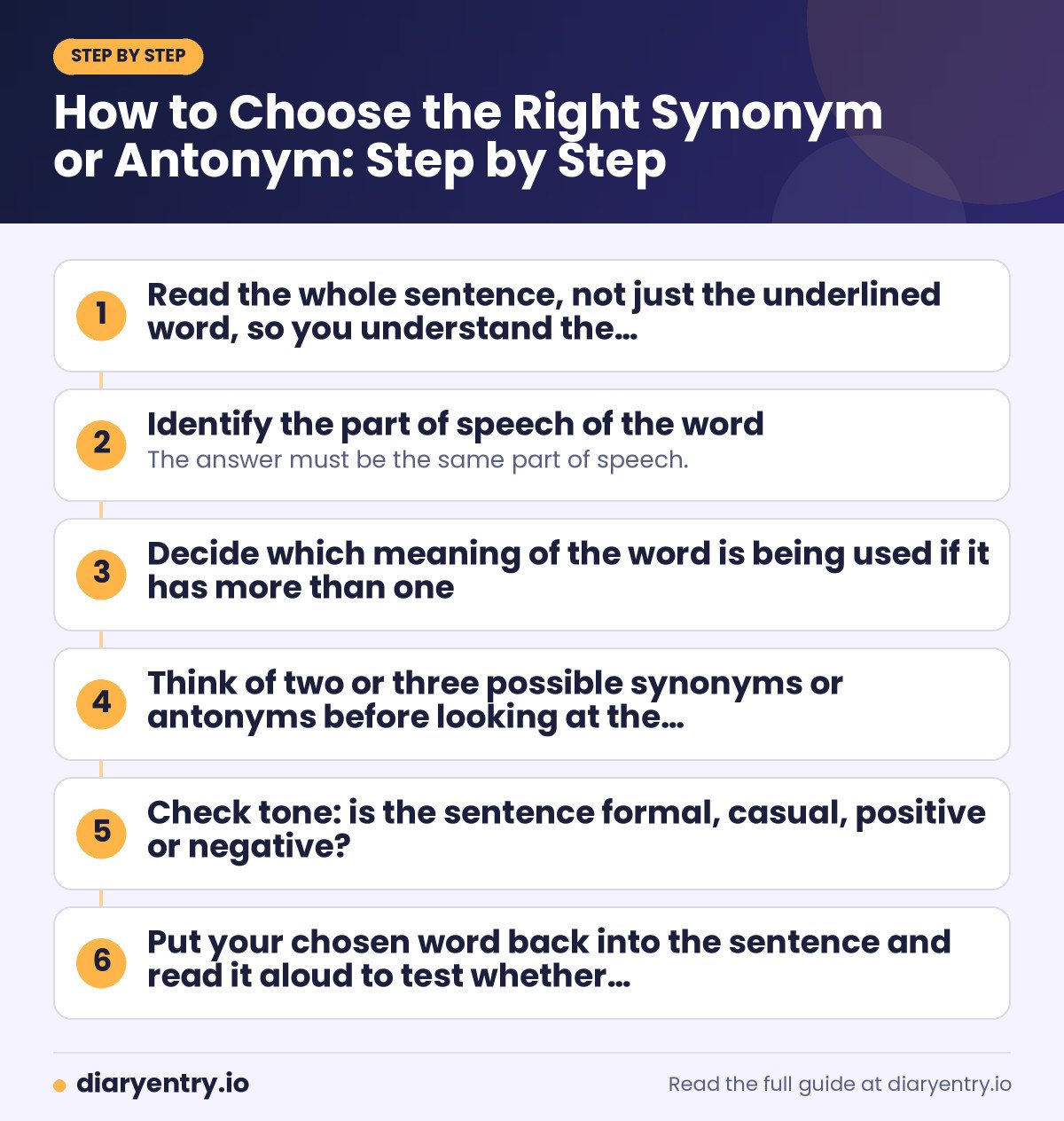
- Read the whole sentence, not just the underlined word, so you understand the context.
- Identify the part of speech of the word. The answer must be the same part of speech.
- Decide which meaning of the word is being used if it has more than one.
- Think of two or three possible synonyms or antonyms before looking at the options.
- Check tone: is the sentence formal, casual, positive or negative?
- Put your chosen word back into the sentence and read it aloud to test whether it sounds natural.
Example: “The manager was reluctant to approve the plan.” Reluctant is an adjective meaning unwilling. A good synonym is hesitant. A good antonym is eager. Test: “The manager was eager to approve the plan” makes sense and gives the opposite meaning.
Synonyms vs Antonyms vs Homophones
Students often mix up three related ideas. Synonyms share meaning, antonyms oppose meaning and homophones share sound. Right and write are homophones: they sound the same but mean different things. If you want to learn those, see our guide to homophones with meaning, list and examples. A fourth term, homonyms, covers words that share spelling and sound but differ in meaning, such as bat (the animal) and bat (for cricket).
Common Mistakes With Synonyms and Antonyms
- Treating synonyms as identical. Famous and notorious both mean well known, but notorious is negative.
- Ignoring part of speech. Do not pick a noun as the synonym of a verb.
- Forgetting multiple meanings. Bank can mean a riverside or a financial institution, and each sense has different synonyms.
- Using a fancy word wrongly. A longer word is not automatically better. Use a word only when you are sure of its meaning.
- Assuming one antonym only. Strong can be opposed by weak, fragile or mild depending on context.
- Memorising lists without sentences. Words learned in context stay in memory longer than words learned in isolation.
Practice Questions
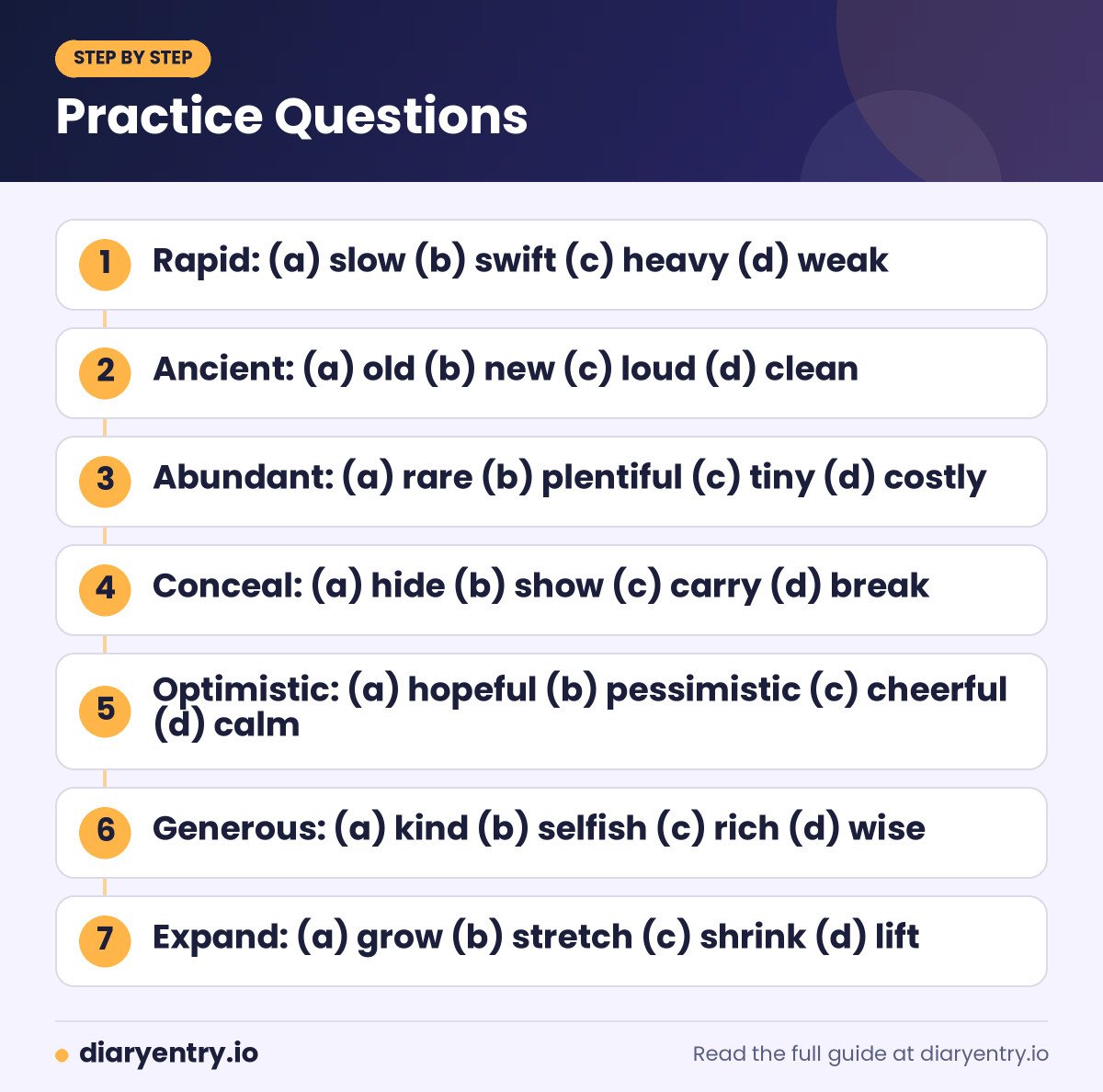
Choose the best synonym for the first four words and the best antonym for the last four.
- Rapid: (a) slow (b) swift (c) heavy (d) weak
- Ancient: (a) old (b) new (c) loud (d) clean
- Abundant: (a) rare (b) plentiful (c) tiny (d) costly
- Conceal: (a) hide (b) show (c) carry (d) break
- Optimistic: (a) hopeful (b) pessimistic (c) cheerful (d) calm
- Generous: (a) kind (b) selfish (c) rich (d) wise
- Expand: (a) grow (b) stretch (c) shrink (d) lift
- Victory: (a) win (b) prize (c) defeat (d) game
Answers: (1) b, swift. (2) a, old. (3) b, plentiful. (4) a, hide. (5) b, pessimistic. (6) b, selfish. (7) c, shrink. (8) c, defeat.
Here is a second exercise for writing. Replace the repeated word in this sentence with synonyms: “The big dog chased the big ball across the big garden.” One improved version is: “The huge dog chased the large ball across the enormous garden.” Notice how varied words make the sentence more interesting without changing its meaning.
Tips to Learn Synonyms and Antonyms Faster
- Learn five new word pairs a day instead of fifty on one day.
- Group words by theme, such as emotions, speed, size or weather.
- Write one sentence for each new word so it is tied to a context.
- Read newspapers, stories and good blogs, and note down new words you meet.
- Use a thesaurus to explore, but check each suggested word in a dictionary.
- Revise old words every week so they move into long-term memory.
- Learn idioms too, because they often hide opposite or similar meanings. Our list of idioms and phrases with meanings and examples is a good place to begin.
Using Synonyms and Antonyms in Diary Writing
Keeping a diary is a gentle, low-pressure way to use new vocabulary. Instead of writing “I was happy” every night, try delighted, relieved, content or thrilled. Instead of “The day was bad”, write exhausting, frustrating or dull. You can even describe a day through contrast: “The morning was tense, but the evening was serene.” Our guide to how to write a diary entry shows how to structure your entries, and the 4-Week Diary Entry Course gives you a daily routine so new words get used regularly instead of forgotten.
Descriptive writing also depends on a rich word choice. If you want to see synonyms at work in vivid prose, read our guide to descriptive writing, its format, techniques and examples.
Frequently Asked Questions
What is the difference between synonyms and antonyms?
Synonyms are words with the same or similar meaning, like begin and start. Antonyms are words with opposite meanings, like begin and end.
Can a word have more than one synonym or antonym?
Yes. Most words have several synonyms, and many have more than one antonym depending on meaning. Light can be opposed by heavy or dark.
Are there perfect synonyms in English?
Almost never. Even close synonyms differ in tone, formality or common usage, which is why context matters when you choose between them.
How do I find synonyms and antonyms for a word?
Use a thesaurus or a good dictionary, then test each option in your sentence. Reading widely also teaches you which words go naturally together.
Are synonyms and antonyms important for exams?
Yes. They appear in school English papers, vocabulary sections of competitive exams and writing tasks, where varied word choice earns better marks.
What is the best way to remember synonyms and antonyms?
Learn them in small daily batches, use each word in a sentence you write yourself, and revise weekly. Diary writing is an easy way to build that habit.
Conclusion
Synonyms and antonyms are simple ideas with big payoffs. Synonyms let you say the same thing in fresh ways, while antonyms help you sharpen contrast and understand meaning faster. Keep the tables above for revision, practise with the exercises, and use your new words in real sentences every day. To see how words fit together in full sentences, continue with our guide to the types of sentences.